Buddha3Bodhi sells Himalayan and Chinese craft jewellery directly at buddha3bodhi.com (screenshot from buddha3bodhi.com).
Jade is the one gemstone where the label on the shelf matters as much as the stone in the box. Two different minerals are sold as “jade”, a grading letter means something very specific in one of them and nothing in the other, and shop categories are often named for a look rather than a material. This guide walks the
Buddha3Bodhi jade range exactly as the shop publishes it – seven collections, 192 distinct listings – and shows how to read the names so you know what you are actually buying.
Everything below was read off Buddha3Bodhi’s own storefront data and policy pages on 2 November 2026. Nothing here grades a stone or values a piece; it maps what the Buddha3Bodhi jade listings say about themselves, which is something any reader can verify in a few minutes. The shop is
here if you want to follow along.
How this review was done
This is a desk review. No piece was bought, handled or tested, and no gemmological opinion is offered. Every number comes from Buddha3Bodhi’s public product feed, its collection pages, two full product pages, the FAQ, the Return Policy page and the Refund Policy page, all read on 2 November 2026. Where the shop says something, this guide says so. Where a collection name and the listings inside it describe different materials, both are reported plainly, with no claim that either is wrong.
One thing worth stating up front: no web page can authenticate jade, and this one does not try. What a careful reader can do is compare a shop’s own words against its own words, and that is what the Buddha3Bodhi jade notes below are.
The seven Buddha3Bodhi jade collections
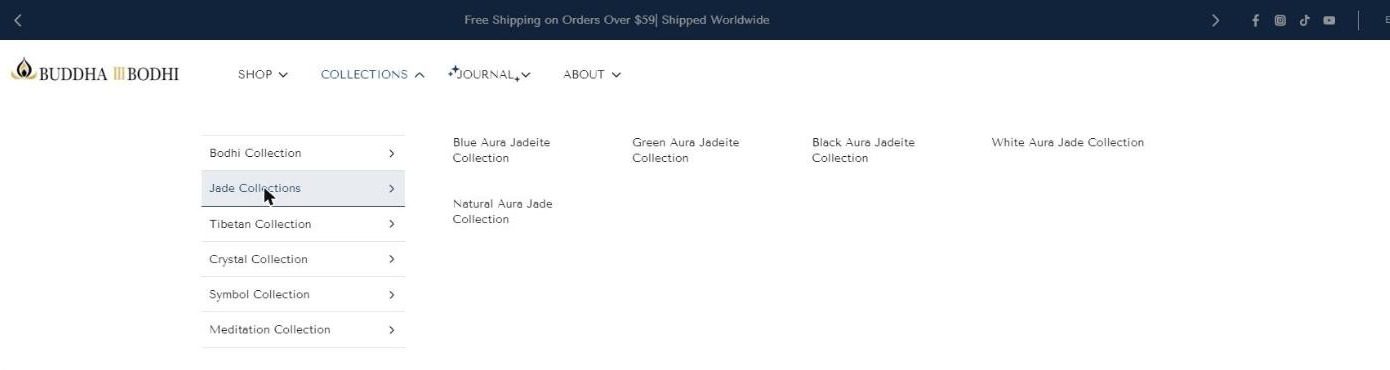
The Jade Collections menu lists five shelves; two more jade collections sit outside it (screenshot from buddha3bodhi.com).
Buddha3Bodhi publishes 59 collections in total, and its catch-all “All Product” shelf reports 1,446 products, so jade is one department inside a broad Himalayan-craft store. The Jade Collections menu opens onto five shelves: Blue Aura Jadeite, Green Aura Jadeite, Black Aura Jadeite, White Aura Jade and Natural Aura Jade.
Two further Buddha3Bodhi jade collections exist in the shop data but are not in that menu – including the largest one of all. If you only browse the menu you will miss Natural Premium Jade, which on its own holds more listings than the five menu shelves combined.
| Collection |
Listings in the shop feed |
In the Jade menu? |
| Natural Premium Jade |
170 |
No |
| Blue Aura Jadeite |
78 |
Yes |
| Natural Aura Jade |
32 |
Yes |
| Green Aura Jadeite |
21 |
Yes |
| Ling Aura Zircon |
19 |
No |
| Black Aura Jadeite |
17 |
Yes |
| White Aura Jade |
17 |
Yes |
Worth noting while you count: the collection data the shop exposes reports slightly higher figures for four of those shelves than the product feed returns – 174 against 170, 79 against 78, 34 against 32, 20 against 19. The likeliest reading is a handful of hidden or out-of-stock listings, and it changes nothing for a buyer, but it is why the numbers in this Buddha3Bodhi jade guide are the feed’s rather than the headline’s.
Seven shelves, 354 slots – but only 192 actual products
Add up the seven Buddha3Bodhi jade shelves and you get 354 places. Strip out the duplicates and there are
192 distinct products carrying
364 variants between them. In other words, the average piece appears on almost two shelves at once.
That is normal merchandising rather than padding, and it has one practical consequence: browsing two Buddha3Bodhi jade collections in a row will show you the same pieces twice, and the real catalogue is about half the size the shelf counts suggest. If you want the whole range in one place, Natural Premium Jade at 170 listings is the closest thing to a master shelf, and it is
on the store.
In the Buddha3Bodhi jade shelves, “Aura” is a name, not a material
Here is the first thing to internalise before shopping, and it takes seconds to check. Five of the seven Buddha3Bodhi jade collections have “Aura” in their names – Blue Aura Jadeite, Green Aura Jadeite, Black Aura Jadeite, White Aura Jade, Ling Aura Zircon. Yet across all
192 product titles in those collections, the word “aura” appears exactly zero times.
No product description in the range uses it either as a material or a treatment. “Aura” is simply how the shop groups its Buddha3Bodhi jade shelves by colour family – blue, green, black, white – the way another shop might say “the green edit”. Read the shelf name as a colour, read the product title for the stone, and the whole range becomes easy to navigate.
Jadeite and Hetian: two different stones in the Buddha3Bodhi jade shelves
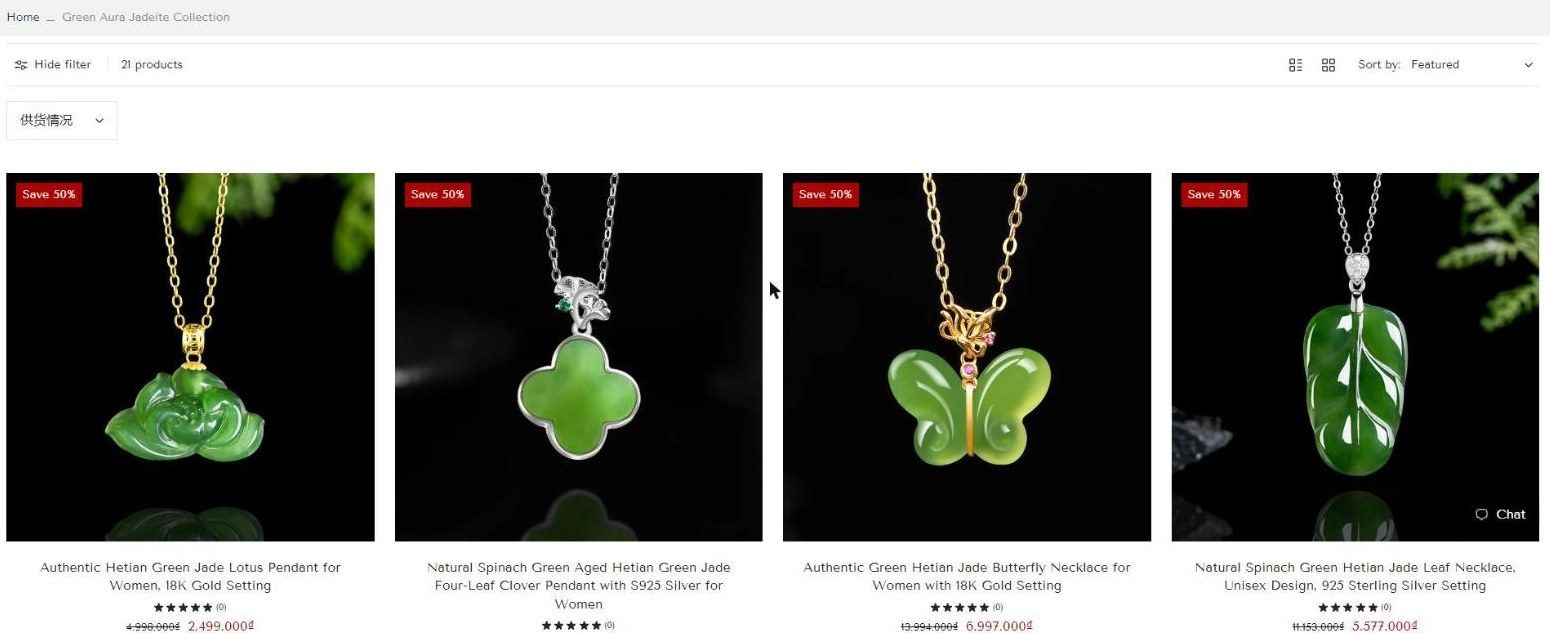
Every listing on the Green Aura Jadeite shelf names Hetian jade in its title (screenshot from buddha3bodhi.com).
This is the single most useful distinction in the whole Buddha3Bodhi jade range, and the shop gives you everything you need to make it – in the product titles. Of the 192 listings,
109 name jadeite and
42 name Hetian jade. Those are not two words for one stone: jadeite and nephrite are distinct minerals, and Hetian is the classic Chinese nephrite. The
United States Geological Survey’s plain-English note on mineral gemstones sets out the difference if you want the geology before you shop.
Where it gets genuinely useful is that the shelf names and the titles do not always line up, and the titles are the reliable ones:
| Shelf |
Listings |
Titles naming jadeite |
Titles naming Hetian |
| Green Aura Jadeite |
21 |
0 |
20 |
| White Aura Jade |
17 |
0 |
17 |
| Blue Aura Jadeite |
78 |
75 |
0 |
| Black Aura Jadeite |
17 |
14 |
1 |
| Natural Aura Jade |
32 |
15 |
3 |
| Natural Premium Jade |
170 |
107 |
42 |
| Ling Aura Zircon |
19 |
0 |
0 (5 name zircon) |
So two shelves with “Jadeite” or “Jade” in the name are, by their own product titles, entirely Hetian nephrite, while Blue Aura Jadeite is almost purely jadeite. Neither is hidden – every title spells out the stone – but a shopper who trusts the shelf heading and skips the title could end up with a different mineral from the one they had in mind.
For any Buddha3Bodhi jade purchase, read the product title, not the shelf.
“A-Grade” is used correctly across the Buddha3Bodhi jade listings
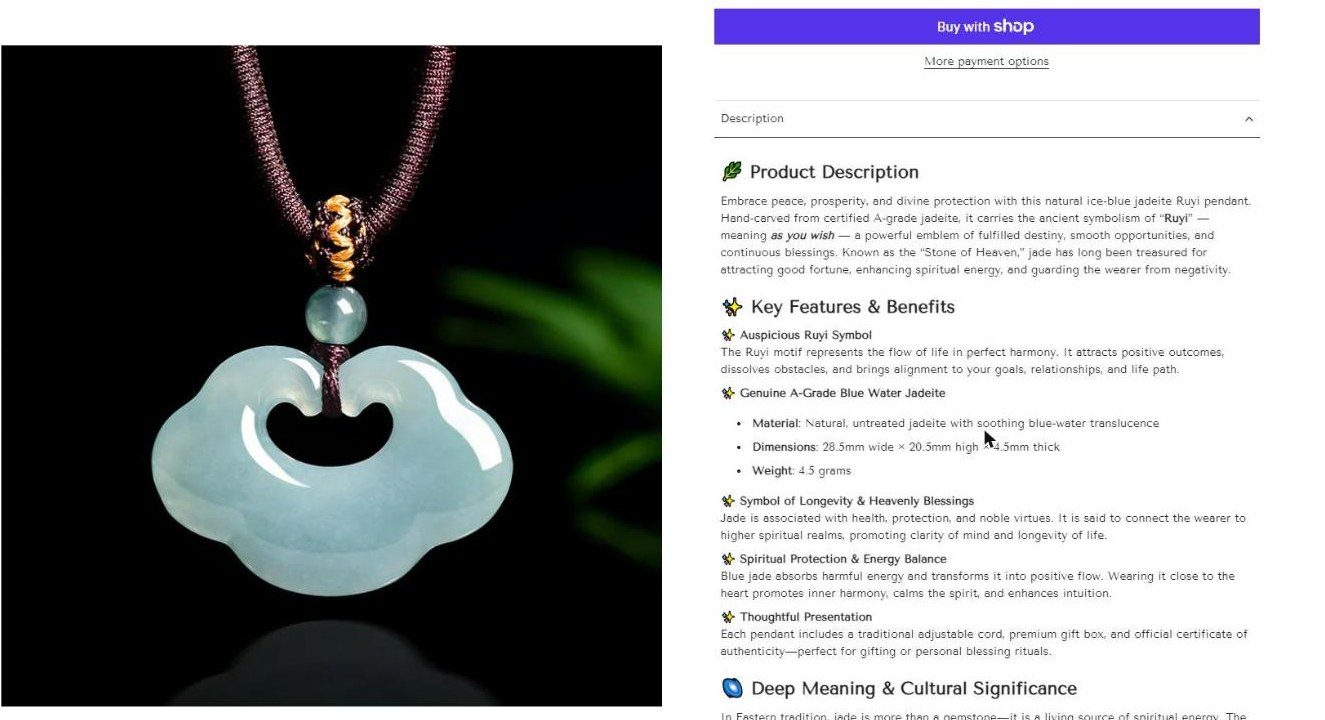
A jadeite listing stating “Natural, untreated jadeite” with exact dimensions and weight (screenshot from buddha3bodhi.com).
“A-Grade” is a jadeite trade term. It does not mean top quality; it means the stone is natural and untreated, as opposed to B-grade (bleached and resin-filled) or C-grade (dyed). It has no meaning at all applied to nephrite. Which makes the way Buddha3Bodhi uses it a genuinely good signal.
Across the 192 Buddha3Bodhi jade titles,
102 carry “A-Grade”. Split them by stone and the pattern is exactly what a careful seller would produce:
95 of the 109 jadeite listings say A-Grade, while
only 1 of the 42 Hetian listings does. The term lands almost entirely where it belongs.
The product pages back it up with the definition rather than just the badge. One blue jadeite pendant lists its material as
“Natural, untreated jadeite”, gives exact dimensions of 28.5 mm wide by 20.5 mm high by 4.5 mm thick, a weight of 4.5 grams, and states that each pendant ships with a traditional adjustable cord, a gift box and
an official certificate of authenticity. That is a lot more specific than this category usually gets, and it is the strongest single quality signal in the Buddha3Bodhi jade range.
What a Hetian listing tells you instead
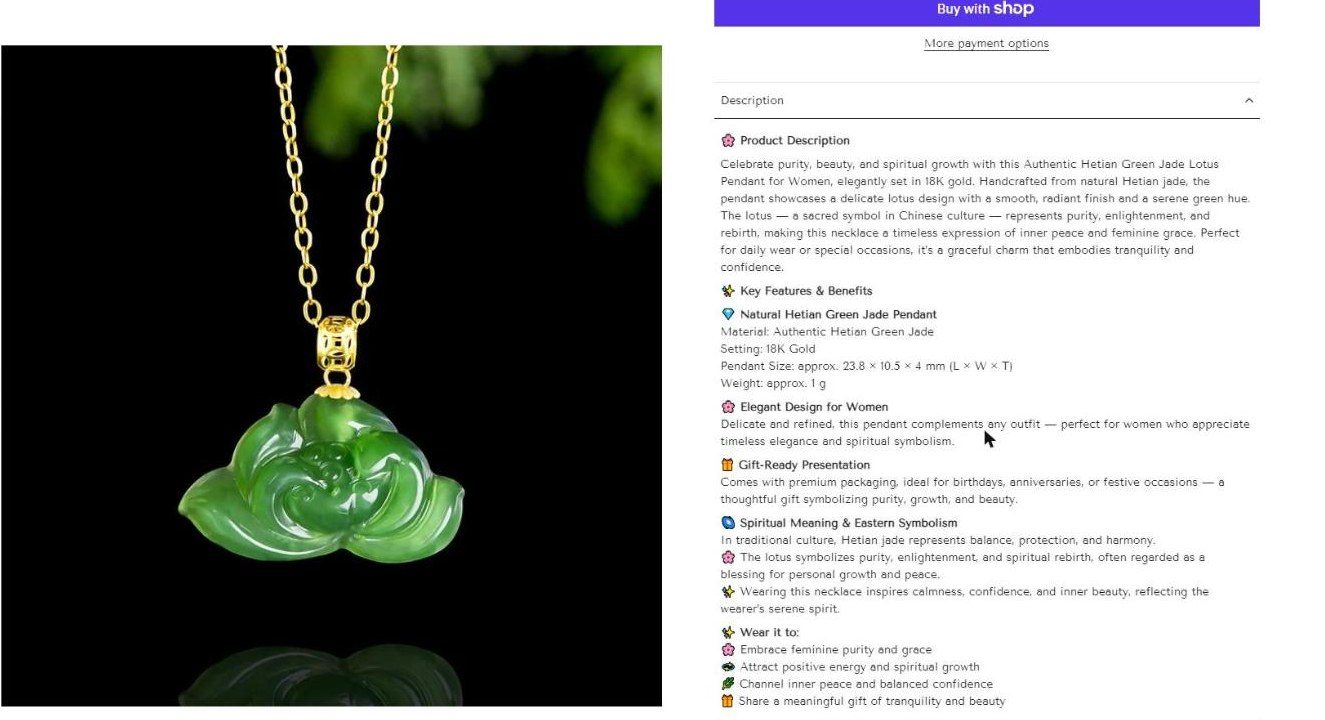
A Hetian jade listing: material, setting, pendant size and weight, all stated (screenshot from buddha3bodhi.com).
Put a Hetian listing beside it and the spec block follows the same shape with different fields. A green Hetian lotus pendant lists its material as “Authentic Hetian Green Jade”, its setting as 18K gold, a pendant size of approximately 23.8 x 10.5 x 4 mm and a weight of about 1 gram, and mentions premium packaging rather than a certificate.
That contrast is the whole lesson of the Buddha3Bodhi jade range in two pages: jadeite listings lead with grade and certification, Hetian listings lead with origin name, setting and dimensions. Both give you measurements in millimetres and a weight in grams, which is more than enough to compare two pieces before buying a Buddha3Bodhi jade piece.
| Field |
Blue jadeite pendant |
Green Hetian pendant |
| Material as stated |
“Natural, untreated jadeite” |
“Authentic Hetian Green Jade” |
| Grade claim |
A-Grade |
None stated |
| Setting |
Adjustable cord |
18K gold |
| Dimensions |
28.5 x 20.5 x 4.5 mm |
23.8 x 10.5 x 4 mm |
| Weight |
4.5 g |
approx. 1 g |
| Included |
Cord, gift box, certificate of authenticity |
Premium packaging |
How the Buddha3Bodhi jade range breaks down by piece
If you know what you want to wear rather than what stone you want, the Buddha3Bodhi jade range sorts quickly. Counting the 192 titles:
- Pendants: 111 – by far the dominant form, and the reason most listings quote a pendant size in millimetres.
- Bracelets: 41 – mostly bead strands rather than bangles.
- Necklaces: 37 – usually a pendant already paired with a chain.
- Rings: 13 and bangles: 4 – the two sizing-sensitive categories, and the smallest.
- 925 sterling silver settings: 34 and 18K or 14K gold settings: 14.
Two more words worth knowing when you scan a Buddha3Bodhi jade grid:
43 titles use “ice” or “icy”, which describes translucence rather than colour, and
8 name Burmese or Myanmar origin. The Natural Premium Jade collection page states outright that it is “crafted from premium A-grade jade sourced directly from Myanmar”, which matches where most of the jadeite in the trade comes from, and it is a useful anchor when you compare two Buddha3Bodhi jade listings side by side.
Buddha3Bodhi jade prices, and which currency you are looking at
A warning before any figure:
Buddha3Bodhi prices by region. Its own store metadata lists the shop currency as USD and its announcement bar advertises free shipping over $59 worldwide, yet a visitor browsing from Vietnam sees every price in dong with a country selector in the header. The number on your screen depends on where you open the page, so the honest way to compare Buddha3Bodhi jade is by ratio and then to check the figure at checkout.
Read as ratios, the range is extremely wide. The cheapest variant in the Buddha3Bodhi jade shelves and the most expensive differ by a factor of
40, with the midpoint sitting at roughly 3.6 times the cheapest. That is a catalogue with a real entry level and a genuine high end, not a flat price band.
| Position across the 364 variants |
Relative to the cheapest |
| Cheapest variant |
1.0x |
| Middle of the range |
about 3.6x |
| Most expensive variant |
40x |
On these shelves, almost everything shows as reduced
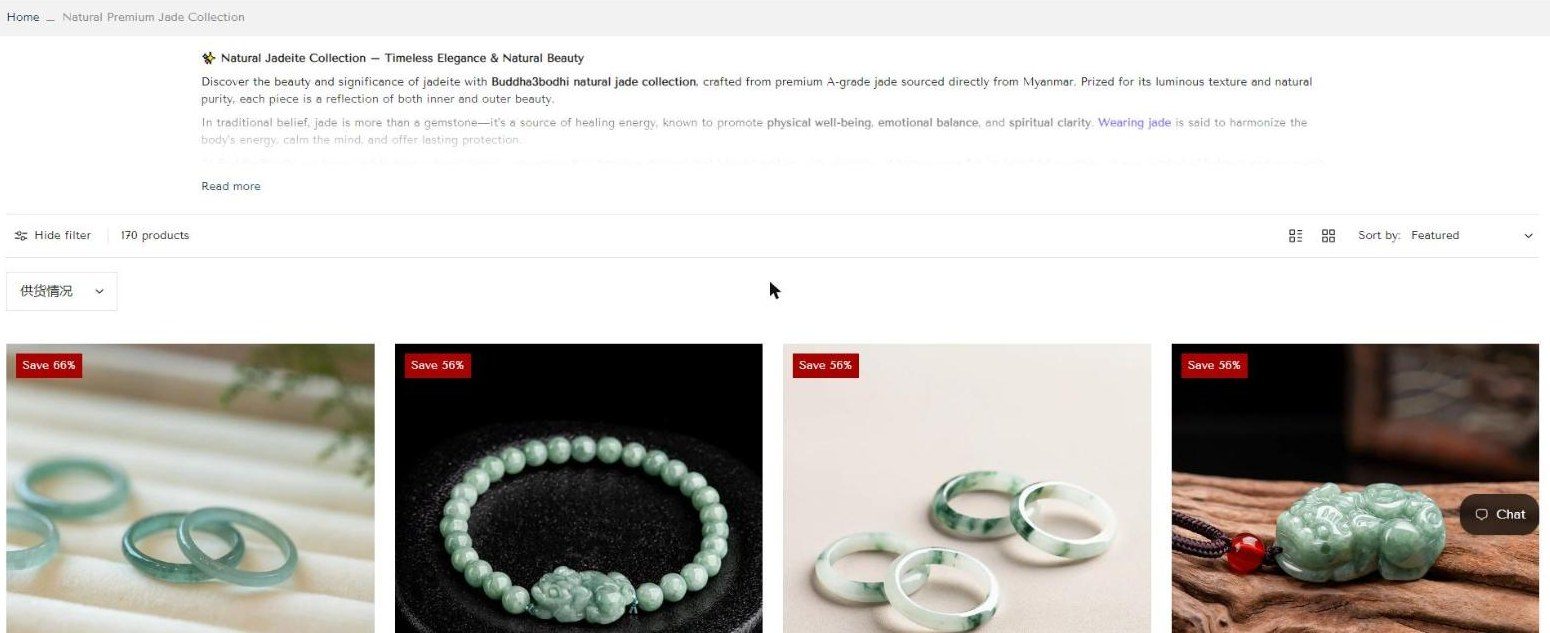
The largest jade shelf, with its own heading, product count and sale badges (screenshot from buddha3bodhi.com).
This is the number that most changes how you read a Buddha3Bodhi jade grid. Of the 364 variants across the seven collections,
349 – about 96 per cent – carry a compare-at price and display as reduced. Sale badges of 50, 56 and 66 per cent sit on the Buddha3Bodhi jade collection pages as standard furniture.
The two sample pendants show the shape of it: the blue jadeite Ruyi displays at roughly 49 per cent below its compare-at figure, the green Hetian lotus at exactly 50 per cent. Add the storefront’s standing BODHI code for a further 10 per cent and the struck-through numbers are best treated as list prices rather than as a window that is about to close.
Nothing about that is concealed – the compare-at figures are printed on every card – but it does mean “on sale” carries no information when you are choosing between two Buddha3Bodhi jade listings. Compare the prices you would actually pay.
Who makes it, and where the shop sits
Buddha3Bodhi describes itself in its FAQ as “an independent brand focused on cultural collectible craftsmanship inspired by Himalayan traditions”, and says “most of our pieces are handmade or hand-finished by artisans in Tibet, Nepal, and surrounding Himalayan regions”, working “in collaboration with artisan communities across Tibet, Nepal, and Newari craft regions”.
It also sets expectations about natural variation rather than glossing over it: “Each piece is individually crafted or selected, so slight variations may occur.” For carved natural stone that is the right framing, and it is the expectation to carry into a Buddha3Bodhi jade order – the piece you receive will be the design you chose, not a pixel-match of the photograph.
On the corporate side, the shop’s storefront metadata lists Buddha3bodhi in
London, England, with a store currency of USD and shipping enabled to most countries. Its listings also carry a short “Giving Back” note stating that the business supports temple repairs and offers prayers for customers – a company statement, published on the product page, and reported here as one.
The collection copy makes wellbeing claims too, and these are
the shop’s claims, presented as claims: it writes that jade “is a source of healing energy, known to promote physical well-being, emotional balance, and spiritual clarity”. No studies are cited, none of it is medical advice, and nothing in this guide endorses it. Jade is jewellery here, and lovely jewellery at that.
Shipping, duties and the 30-day window on a Buddha3Bodhi jade order
The FAQ is specific where it matters. Orders are “typically processed and shipped within 1-3 business days”, delivery “typically takes 5-14 business days after dispatch”, every order includes tracking, and the clock on delivery starts at dispatch rather than at checkout. The shop ships worldwide to most countries and says plainly that customs duties or taxes may apply depending on destination.
| Stage |
What Buddha3Bodhi states |
| Processing |
1-3 business days |
| Delivery after dispatch |
5-14 business days |
| Tracking |
Included on all orders |
| Free shipping |
Advertised over 59 dollars, worldwide |
| Customs and duties |
May apply, depending on destination |
| Return window |
30 days from receipt |
| Extended warranty |
1 year, available to purchase separately |
Put together, a Buddha3Bodhi jade order is a two-to-three week proposition for most destinations. The 30-day return window runs from receipt rather than from order, which is the buyer-friendly version of that clock.
Returning Buddha3Bodhi jade: three pages, three versions of who pays

The 30-day returns note that appears on the product page itself (screenshot from buddha3bodhi.com).
All three of Buddha3Bodhi’s return texts agree on the headline –
30 days from receipt, refund or exchange – and the Return Policy page goes further with a “30 Day Satisfaction Guarantee” that covers simply changing your mind. Where they differ is on who pays the return postage.
| Where it appears |
What it says about return shipping |
| Product page accordion |
“return the item to us within 30 days for a full refund or exchange. We will handle the rest.” |
| Return Policy page |
“Yes, you need to cover shipment if you wish to return an item to us.” |
| Refund Policy page |
Customer covers return shipping “unless the item received is defective, damaged upon arrival, or incorrect.” |
The Refund Policy version is the most detailed and the most generous in the case that matters most – a damaged or incorrect item – while the product-page wording is the breeziest. They are not irreconcilable, but they are three different sentences about one question, so for a Buddha3Bodhi jade return it is worth getting the answer in writing first. The mechanics are clearly set out either way: email sales@buddha3bodhi.com, expect the return address within 24-48 hours, keep the item unused and ideally in its original packaging, use a tracked service, and the refund follows 1-2 days after the parcel arrives, with card refunds taking up to five working days to land.
Who the Buddha3Bodhi jade range fits
A good fit if you want carved jade jewellery where the stone, the grade, the setting, the millimetre dimensions and the weight are printed on every listing; if you like that “A-Grade” is applied to jadeite and almost never to nephrite; if a certificate of authenticity with the jadeite pieces matters to you; and if a two-to-three week tracked delivery with a 30-day return window suits how you buy.
Worth a second thought if you shop by category heading rather than by product title, because two “Jadeite” and “Jade” shelves are entirely Hetian nephrite by their own titles; if you need an exact visual match to the photograph, since the shop says every piece varies; if you want the price in your own currency before checkout, because the storefront picks the currency for you; or if you want return postage settled in advance, in which case ask before ordering.
None of those are faults in the Buddha3Bodhi jade range – they are its shape, and the shop publishes enough detail for a buyer to work all of them out before spending anything. The full range is
on the Buddha3Bodhi store if you want to see where you land.
The short version
Seven collections, 354 shelf slots, 192 real products, 364 variants. The Buddha3Bodhi jade range is unusually easy to compare because every listing carries the same spec fields – material, grade where it applies, setting, dimensions in millimetres and weight in grams – and because the product titles always name the stone.
The things to know before ordering are small and checkable. “Aura” is a colour grouping, not a material – it appears in zero product titles. Jadeite and Hetian nephrite are different stones, and two shelves named for one contain the other. “A-Grade” is used properly: 95 of 109 jadeite listings, 1 of 42 Hetian. About 96 per cent of variants show as discounted, so “on sale” is not a signal here. And three pages describe return postage three different ways, so get that in writing first.
Overall: 8.2 / 10 – a well-documented, carefully labelled Buddha3Bodhi jade catalogue with honest wording about craftsmanship and natural variation and correct use of jadeite grading, held just short of top marks by shelf names that do not always match the stone inside, region-set pricing, and return-shipping terms that read differently on three of the shop’s own pages. Current pieces and live prices for your region are
on the Buddha3Bodhi store.